
.jpg)
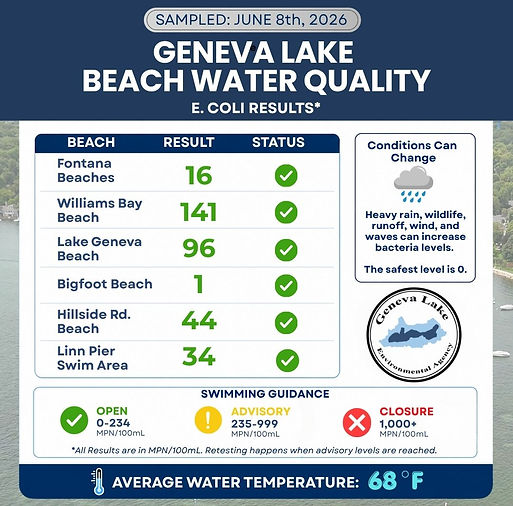
Last Posted Levels
Weekly Process
GLEA monitors E. coli bacteria levels at public beaches around Geneva Lake by collecting water samples every Monday during the summer. These levels help indicate the potential presence of harmful germs. Results are shared with local municipalities and posted on GLEA’s Facebook, Instagram, and website page (www.gleawi.org) within 24 hours. While these tests provide a helpful snapshot of water quality, conditions can change quickly due to weather, wildlife, runoff, or wave activity. One area may test clear, while another nearby area may contain higher levels of bacteria. GLEA posts counts taken from 1–3 sample points at each beach location. If levels are high, GLEA retests until levels are within EPA standards and continues to post updates to the public.
Please remember, even when results fall within safe limits, water and bacteria are continuously moving. An E. coli level of 0 is the safest possible reading. Always swim with caution - especially children who are more vulnerable to exposure.
Recommended Safety Tips:
-
Avoid swallowing water.
-
Shower after swimming.
-
Don’t swim with open wounds or recent illness.
-
Wash hands before eating if they’ve been in contact with lake water.
Beach Safety Signs (Updated Every Tuesday Based On Testing):
-
Green (0-235) = No advisory in place.
-
Yellow (235-999) = Advisory in effect: swim with caution, especially for children or immunocompromised individuals.
-
Red (1,000 and above) = Beach closed: unsafe levels detected (per DNR guidelines - Wisconsin Department of Natural Resources)
All About E. Coli

E. coli (Escherichia coli) is a type of bacteria commonly found in the intestines of humans and animals. While most strains are harmless and play an important role in healthy digestion, their presence in lake water can indicate that fecal contamination has entered the system through stormwater runoff, wildlife, or other sources. Because some strains can cause illness, E. coli is used as a key water-quality indicator to help determine when swimming or recreational contact may pose a health risk. GLEA regularly monitors E. coli levels around Geneva Lake to help ensure safe and informed lake use.
Lake water naturally contains many types of bacteria beyond E. coli, including those that break down organic matter, support nutrient cycles, or arrive through runoff after rainfall. Most of these microbes are harmless and play essential roles in a healthy aquatic ecosystem, but certain conditions—such as warm temperatures, heavy storms, or high nutrient levels—can cause some bacteria to increase. To learn how GLEA tests for these bacteria and what our results mean for public health and recreation, please see the testing information further down this page.
History of E. Coli at Our Beaches


SWIMMERS ITCH
How to stay safe this summer
Swimmer's itch is caused by flatworm larvae that can unintentionally latch onto human skin when looking for a waterfowl host and cause irritation or itchiness. They like warm water at around 72°F. When your skin dries, the larvae will burrow into the skin and eventually die, but this typically results in some uncomfortable itchiness.